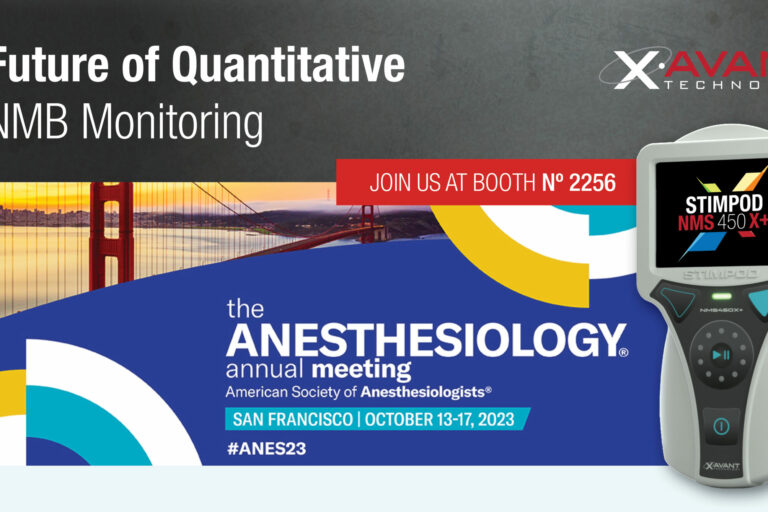
The NMS410 and NMS450 feature a charge transfer waveform that indicates the exact charge that is transferred to the patient. This provides real-time feedback to the anesthesiologists to indicate the stimulus waveform.
Please click here to book a demonstration
1. It is possible for a proficient NS user to obtain a 95 - 98% success rate.
2. The capital outlay for equipment is much lower.
3. Ultrasound has a much longer learning curve compared to NS.
4. The equipment is more compact and portable in terms of the power source.
5. The Nerve Stimulator offers reduced set up time.
The Stimpod offers a maximum current of 20mA on the nerve mapping modality. This enables you to effectively target most of the peripheral nerves for nerve blocks.
With the new combination cable, the Stimpod significantly decreases the procedural time for performing nerve blocks.
The Stimpod only requires three steps for effective nerve location:
1. Plug in the combination cable.
2. Map the superficial nerves.
3. Insert the needle at the intended puncture site.
The STIMPOD provides an elegant solution for the potential high impedance in the closed circuit by graphically indicating the resulting shape of the applied stimulating square wave. This allows the user to immediately observe the incidence of high impedance.
The Stimpod provides a versatile, ergonomic, integrated enclosure offering different ways of attachment i.e. standing, hanging, etc.
The Stimpod is more durable with no external mechanical moving parts. It is easy to clean and disinfect therefore offering a simple solution for sterile usage.
The Stimpod NMS450 offers full NMBA monitoring functions.
Apart from the actual current that is delivered, the Stimpod also displays the average charge delivered.
The main purpose of the Proximity Indicator is to alert the user to the fact that he/she may be too close to the nerve, which may result in nerve damage. The range of charge settings at which the needle tip is at the optimal distance from the nerve is also adjustable.
| Features | Benefits |
|---|---|
| Sterility | Due to the fact that the user controls do not consist of any moving parts, the Stimpod can easily be covered with see-through sterile cover without interfering with the user interface. |
| Attachment Mechanism | Offers a versatile, ergonomic clip that can be used as a stand, hook or clip. It offers a versatile & ergonomic solution to secure device placement. |
| User Interface | Four high quality membrane-switch buttons and a capacitive sensing wheel form a simple and intuitive keypad layout. All device parameters are displayed. Visual & Auditory stimulation feedback. |
| Waveforms | Stimpod offers superior performance in terms of stimulus shape, linearity and consistency. |
| Non-linear adjustment | Choose between Linear (normal) and Non-Linear progression of current and pulse width settings. Non-Linear mode allows the user to customize 20 current and pulse width setting positions. |
| Proximity range | Provides visual & auditory feedback when target current and pulse width ranges are reached. |
| Intelligent cables | A cable can identify itself and communicate its functionality with the Stimpod. For instance the combined Nerve Mapping/ Locating cable has the ability to recognize which of its cathodes are in use. |
| Mapping & locating combination cable | Increased ease of procedure and reduced procedural time. |
| Real time feedback | It improves the efficiency of procedures. |
| Diagnostic screen | Ease of operation and functionality. |
| Nerve mapping probe | The ergonomic Nerve Mapping Probe presents the user with a simple and reliable Nerve Mapping solution. The surgical steel tip is small enough to provide good neuronal selectivity while still providing enough contact-surface to minimize densities. |
Yes. It is possible for a proficient user of Nerve Stimulators to obtain a 95 to 98% success rate. In order for physicians to become proficient it would be advisable to attend conferences and workshops.
Contact your local distributor for further details.
The Stimpod was designed with single button operation in mind - it has one button for pulse width, one for frequency and a dial for current intensity adjustment. In addition there is a pause button that can pause the stimulation. This enables you to immediately change the most relevant parameters.
The combination cable reduces nerve location with nerve mapping to a simply 3 step soluition:
1. Plug-in of the combination cable.
2. Map the superficial nerves.
3. Insert the needle at the intended puncture site.
The cable auto-detects which cathode is in contact with the patient, i.e. the mapping probe or the needle, and automatically directs the current and changes the current limits.
The proximity setting provides an audible and visual confirmation that the target range has been reached. The default settings indicate a range between 60nC (High) and 30nC (Low).
This equates to the following settings:
| Pulse Width | 0.05ms | 0.1ms | 0.3ms | 0.5ms | 1.0ms |
|---|---|---|---|---|---|
| Current High | 1.2mA | 0.6mA | 0.2mA | 0.12mA | 0.06mA |
| Current Low | 0.6mA | 0.3mA | 0.1mA | 0.06mA | 0.03mA |
Please note that the parameters for proximity indication is defined in Coulomb or Charge which allows the device to adjust the target current ranges automatically when different Pulse-Widths are selected.
The upper and lower charge thresholds are adjustable in the main MENU.
The NMS450 has the added capability to monitor Neuro-Muscular Blocking Agents used during General Anesthesia. Both the units can be used to perform Nerve Location and Nerve Mapping for Regional Anesthesia procedures.
Refer to the User Manual for detailed descriptions.
The diagnostics screen offers the user qualitative real-time feedback of:
1. The shape of the stimulating waveform. This is significant because of the possible existence of a component in the closed circuit which could introduce an excessively high impedance into the circuit, such as a dried out ECG electrode, very oily or dry skin etc. If all the components in the closed circuit has a total impedance in excess of 20kΩ (Nerve Locating or Nerve Mapping Modes) the STIMPOD device may not be able to deliver a constant current for the duration of the square wave, due to its maximum output voltage of 100V in the Nerve Location mode and 400V in the Nerve Mapping Mode. This is easily observed visually on the graphics section of the Diagnostics Screen where a waveform will be displayed which is not perfectly square.
Thus, the Diagnostic Screen offers an immediate indication when the impedance limit of the STIMPOD is reached.
2. Current setting is indicated by the dotted line.
3. The proximity indicators are indicated by the up and down arrow.
The STIMPOD allows for a current range of 0.0mA to 5.0mA.
A typical procedure would start at a higher current i.e. >2mA for initial nerve location. As the needle progresses closer to the nerve, the current is reduced.
A typical range for final location is usually between 0.3mA and 0.6mA (at a 0.1ms pulse width setting).
This range also represents the default settings of the Proximity Indicator.
Note: Always include the pulse width setting when referring to a current range for nerve location, as it is the total Charge intensity (i.e. Current Intensity x Pulse Width) that contributes to the strength of the neuromuscular response.
The intelligent cables allow the following:
1. Automatic cable identification: When a cable is inserted into the STIMPOD, the STIMPOD has the ability to recognize the cable and switch to the appropriate functional modality, for instance Nerve Location Mode or NMBA Mode.
2. Auto-sense technology: In Nerve Mapping/ Locating Mode the cable has the ability to recognize which of its cathodes are touching the patient and adjust the current mode accordingly. Both the Mapping/Locating combination cable and the Locating cable also uses this technology to initiate a stimulus once a closed circuit is detected.
3. Cable communication. In NMBA Mode the STIMPOD communicates with the Accelerometer in order to gain real-time feedback of the strength of contraction of the stimulated appendage.
Nerve Location utilizing Neuromuscular Stimulation is based on the correlation between a specific current intensity at a specific pulse width and the distance of the cathode (Needle Tip or Nerve Mapping Probe) to a nerve when a neuromuscular response is facilitated.
Thus, a contraction is facilitated when sufficient Charge (a specific current intensity at a specific pulse width) is delivered to depolarize the nerve (which will cause a contraction) when the needle is a certain distance from the nerve.
The STIMPOD incorporates different functional modalities which find application in both Regional Anesthesia (Nerve Mapping and Nerve Locating) and General Anesthesia (NMBA Monitoring - NMS450 only).
NMBA (Neuro-muscular Blocking Agent) mode is used to monitor neuro-muscular blocking agents. Neuro-muscular blocking agents are used during general anesthesia i.e. during intubation. It is important for the anesthesiologist to monitor the onset of the blocking agent, as this can differ from patient to patient. Once the agent is working, the anesthesiologist now has to monitor the agent to ensure that it does not suddenly reverse during the procedure. Once the procedure is finished, the agent is reversed. This reversal can be induced though a reversal agent or just by waiting for the agent to reverse. During this period it is possible that residual blocking agent can still be present in the patient, causing such adverse effects as apnea. By using the STIMPOD the anesthesiologist will be able to distinguish whether this is caused by residual blocking agent or not. Once the STIMPOD indicates full reversal, the patient can safely be moved to the recovery ward.
Various topics regarding nerve stimulation are addressed in the KNOWLEDGE section. Contact your local distributor for further details regarding one-on-one training.
It depends on the usage frequency and product handling. Xavant Technology prides itself on the high quality of its products and the products are built to last.
Contact your local distributor for further details.
Xavant Technology has been manufacturing stimulators since 1998 while the first Stimpod product was placed on the market in 2007. A one-year warranty is provided. Units that are serviced outside of the warranty period accounts for less than one percent of all units sold.
The current Stimpod models, the NMS410 and the NMS450, are the newest model in a string of successful nerve stimulators. Xavant Technology is continually enhancing their product ranges. We have always lead the way through research and new product development, and the features incorporated into the new models are based on direct feedback from anesthesiologists, resulting in a product that is practical in its application and day-to-day use.
Do you have more questions? Please contact us!